What Is Payment Retry Orchestration (and Why It Matters for Authorization Performance)
Learn what payment retry orchestration is, how it differs from basic retries and dunning, and why it plays a critical role in authorization performance.

What Is Payment Retry Orchestration? A Technical Guide for Payment Teams
Introduction
Payment failures are a structural characteristic of card-based payments, not an edge case. Even in optimized payment stacks, a portion of authorization attempts will fail due to insufficient funds, issuer risk controls, authentication requirements, or transient technical issues.
A subset of these failures is recoverable - but only under the right conditions.
Payment retry orchestration refers to the system-level process of determining whether, when, and how to reattempt a previously declined transaction in a way that maximizes recovery while remaining compliant with network rules and issuer expectations.
This article provides a precise definition of retry orchestration, explains how it works in practice, and outlines the constraints imposed by card networks and issuers.
Why Payments Fail: A Structured View
Card payment declines fall broadly into three categories:
1. Hard declines (non-recoverable)
Examples:
- Lost or stolen card
- Closed account
- Invalid card number
These should not be retried. Stripe explicitly excludes hard decline codes from retry logic, as retries are unlikely to succeed and may create unnecessary network traffic.
2. Soft declines (conditionally recoverable)
Examples:
- Insufficient funds
- Temporary issuer risk rejection
- Authentication required (e.g., SCA / 3DS)
Soft declines are often recoverable if retried under different conditions. For example, Adyen explains that certain declines require Strong Customer Authentication and must be retried with 3DS in its 3DS2 implementation guide.
3. Technical or transient failures
Examples:
- Processor timeouts
- Network errors
- Temporary issuer unavailability
These failures are often recoverable through retrying, sometimes with routing or timing adjustments.
Network Constraints: Retry Is Not Arbitrary
Retry orchestration is constrained by card network rules.
Visa defines categories of declined transactions and provides guidance on whether and how they may be retried. In some cases, repeated retries are allowed but must follow specific constraints (e.g., limits within a defined time window).
Mastercard provides Merchant Advice Codes (MACs), which indicate whether a transaction should be retried and sometimes how long to wait. These are exposed by processors such as Adyen in their raw acquirer response documentation.
Examples of issuer guidance:
- Retry after a defined delay (e.g., hours or days)
- Do not retry (e.g., suspected fraud or closed account)
- Retry with updated credentials or authentication
Retry orchestration systems must interpret and respect these signals.
What Is Payment Retry Orchestration?
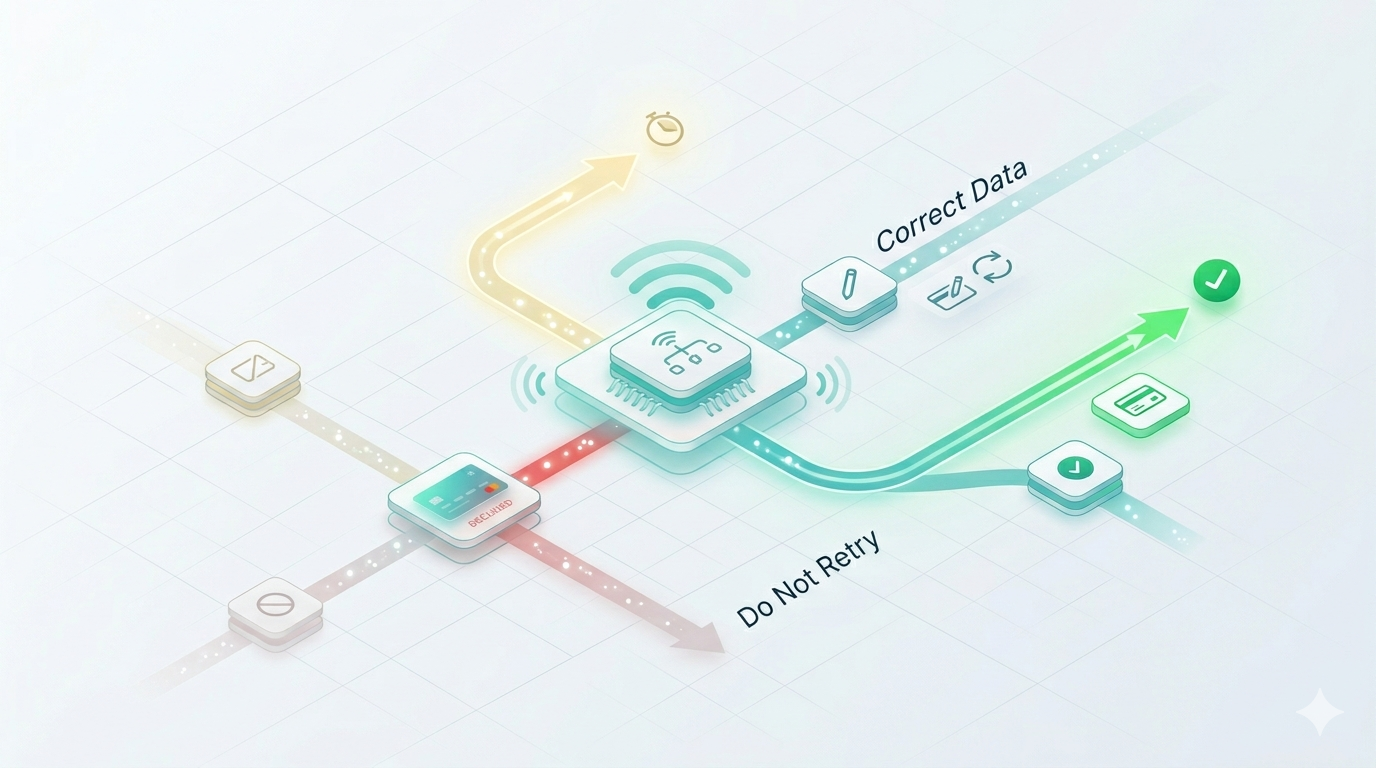
Payment retry orchestration is a decision layer that evaluates a declined transaction and determines:
- Whether the transaction should be retried
- When the retry should occur
- Under what conditions the retry should be executed
This includes:
- Interpreting issuer response codes and network signals
- Applying timing strategies based on decline type
- Adjusting execution parameters (e.g., authentication, routing, credentials)
It is distinct from simple retry logic, which typically applies fixed retry intervals without contextual decisioning.
Core Components of Retry Orchestration
1. Decline classification
The system must distinguish between:
- Non-retryable declines (hard)
- Retryable declines (soft or transient)
- Conditional cases requiring modification (e.g., add 3DS)
This classification is typically based on:
- Network response codes
- Processor-level normalized decline codes
- Merchant Advice Codes (where available)
2. Timing optimization
Timing is a primary driver of recovery.
Payment processors explicitly optimize retry timing. Stripe explains that its Smart Retries system uses behavioral and transactional signals to determine optimal retry timing instead of fixed schedules.
Issuer guidance may also dictate timing (e.g., retry after 24 hours), which must be respected.
3. Execution strategy
A retry is not always a simple reattempt of the same request.
Possible execution adjustments include:
- Adding 3DS authentication after a soft decline
- Using updated card data (via Account Updater)
- Switching routing paths (where orchestration is available)
- Adjusting transaction metadata or flags
For example, Mastercard guidance surfaced via Adyen’s Merchant Advice Code documentation may indicate that account details should be updated rather than retried unchanged.
4. Suppression logic
Equally important is deciding when not to retry.
Retries should be suppressed when:
- The decline is explicitly non-retryable
- Network rules prohibit further attempts
- The probability of success is low relative to cost
Uncontrolled retries increase unnecessary authorization attempts and may violate scheme expectations.
Retry Orchestration vs. Related Recovery Mechanisms
Retries are only one part of payment recovery.
Other mechanisms include:
Account Updater
Visa describes its Visa Account Updater as a service that automatically updates expired or replaced card details.
Network tokenization
Mastercard’s network tokenization framework maintains up-to-date credentials through token lifecycle management.
Customer intervention (dunning)
Requests updated payment details or user action.
Authentication flows (3DS)
Required in many soft decline scenarios under PSD2.
A robust recovery system determines whether retrying is the correct action or whether another mechanism should be used instead.
Example Decision Scenarios
ScenarioRecommended ActionInsufficient fundsRetry after delay (issuer-dependent) Soft decline requiring SCARetry with 3DS authenticationExpired cardUse Account Updater or request new detailsSuspected fraudDo not retryProcessor timeoutRetry, potentially via alternate route
Measuring Retry Orchestration Performance
Key metrics include:
Recovery rate
Percentage of previously declined transactions successfully recovered.
Incremental recovered revenue
Recovered value attributable specifically to retries, compared to a baseline.
Authorization rate impact
Effect of retries on overall authorization performance.
Retry efficiency
Success rate per retry attempt, measuring how targeted retries are.
Measurement should ideally use controlled comparisons (e.g., holdout groups or pre/post matched cohorts) to isolate the impact of retries.
Implementation Considerations
A production-grade retry orchestration system requires:
- Access to detailed decline signals (including network-level data where available)
- A classification layer for decline types
- A timing engine informed by issuer behavior and historical outcomes
- Compliance with scheme rules (Visa, Mastercard)
- Integration with adjacent recovery systems (updater, tokenization, authentication)
Retry orchestration is therefore not a standalone feature - it is part of a broader payment optimization system.
Conclusion
Payment retry orchestration is the controlled, rule-aware process of recovering failed payments through selective reattempts.
It operates under three constraints:
- Issuer behavior and response signals
- Card network rules
- Transaction-level context
Some modern systems extend retry orchestration beyond scheduling and decisioning by assuming financial responsibility for recovery outcomes rather than only attempting retries - for example, platforms like Better operate on a model where recovery is not only attempted but contractually guaranteed under defined conditions, representing a shift from optimization toward outcome-based recovery.
When implemented correctly, retry orchestration enables recovery of a portion of failed payments without introducing unnecessary network load or violating scheme expectations.